By admin
January 27, 2026
By admin
January 27, 2026
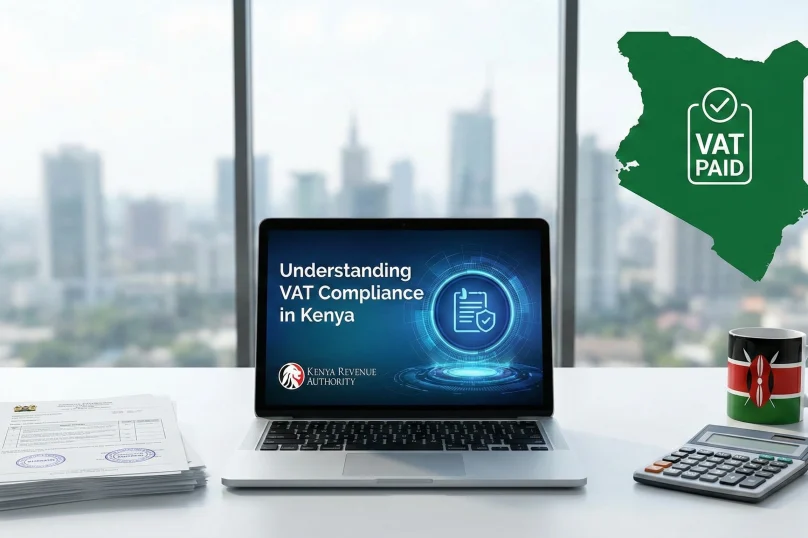
Value Added Tax (VAT) remains one of the most closely monitored taxes in Kenya. In 2026, compliance is no longer just about filing returns — it is about accurate documentation, proper invoicing, and real-time data matching through eTIMS.
Whether you are an SME, professional service provider, landlord, importer, or growing business, understanding the current VAT rules is critical to avoid penalties, audits, and cashflow disruptions.
Who Is Required to Register for VAT?
You are required to register for VAT if:
- Your annual taxable turnover exceeds KSh 5 million, or
- You expect to exceed this threshold within a 12-month period, or
- You are dealing in VAT-able supplies and KRA requires registration
Businesses below the threshold may register voluntarily, but once registered, full VAT compliance is mandatory.
Current VAT Rate in Kenya
- Standard VAT rate: 16%
- Applied to most goods and services unless specifically exempt or zero-rated under the VAT Act
VAT Categories Explained
1. Standard-Rated Supplies (16%)
These attract VAT at 16%. Examples include:
- Most professional services
- Commercial goods
- Retail and wholesale supplies
VAT charged must be declared and remitted to KRA.
2. Zero-Rated Supplies (0%)
VAT is charged at 0%, but input VAT is claimable. Common examples include:
- Exported goods
- Certain agricultural inputs
3. Exempt Supplies
No VAT is charged, and input VAT is NOT claimable. Examples include:
- Financial services
- Residential rent
- Certain educational and medical services
Understanding this distinction is crucial, as incorrect classification leads to rejected VAT claims.
Input VAT: What You Can Claim
Input VAT can only be claimed if:
- The supplier issued a valid eTIMS electronic tax invoice
- The invoice appears in your eTIMS system
- The expense relates directly to taxable business activity
- The claim is made within the allowed time period
⚠ Without an eTIMS invoice, input VAT is disallowed — even if payment was made.
Output VAT: Your Obligation
Output VAT is VAT you charge your customers. You must:
- Issue eTIMS invoices for every taxable sale
- Declare output VAT in your monthly VAT return
- Remit VAT to KRA by the due date
VAT Filing & Payment Deadlines
- VAT returns: Due by the 20th of the following month
- Applies even if there was no activity (Nil return required)
- Late filing or payment attracts:
- Penalties
- Interest
- Possible compliance enforcement
Role of eTIMS in VAT Compliance
In 2026, VAT compliance is fully system-driven.
KRA automatically validates:
- Sales declared vs eTIMS invoices issued
- Input VAT claimed vs supplier eTIMS records
- Imports vs customs data
Any mismatch may lead to:
- Disallowed VAT claims
- System errors during filing
- Audits and assessments
Common VAT Compliance Mistakes
Businesses often get penalized due to:
- Claiming VAT from non-eTIMS invoices
- Using suppliers not registered or compliant
- Incorrect classification of exempt vs taxable supplies
- Late filing of VAT returns
- Poor record-keeping and reconciliation
Penalties for Non-Compliance
Failure to comply with VAT rules may result in:
- Late filing penalties
- Interest on unpaid VAT
- Disallowed input VAT
- Audits and assessments
- Cashflow strain from unexpected tax bills
Best Practices for VAT Compliance in 2026
To stay compliant:
- Register correctly when required
- Use eTIMS for all taxable transactions
- Reconcile VAT monthly
- Keep proper records and supporting documents
- Work with a professional advisor
At Juma Auditors, we help businesses and individuals with:
✔ VAT registration & advisory
✔ Monthly VAT return filing
✔ eTIMS setup & compliance
✔ VAT reconciliation & audits
✔ Input VAT review & recovery
✔ Ongoing tax compliance support
📍 Website: www.jumaauditors.co.ke
📞 Phone: 0725 948 551
VAT compliance in Kenya is no longer optional or informal. With real-time data matching and strict enforcement, accurate records and correct VAT treatment are essential.
If you’re unsure whether you are compliant, it’s better to review now than face penalties later.