By admin
May 8, 2026
By admin
May 8, 2026
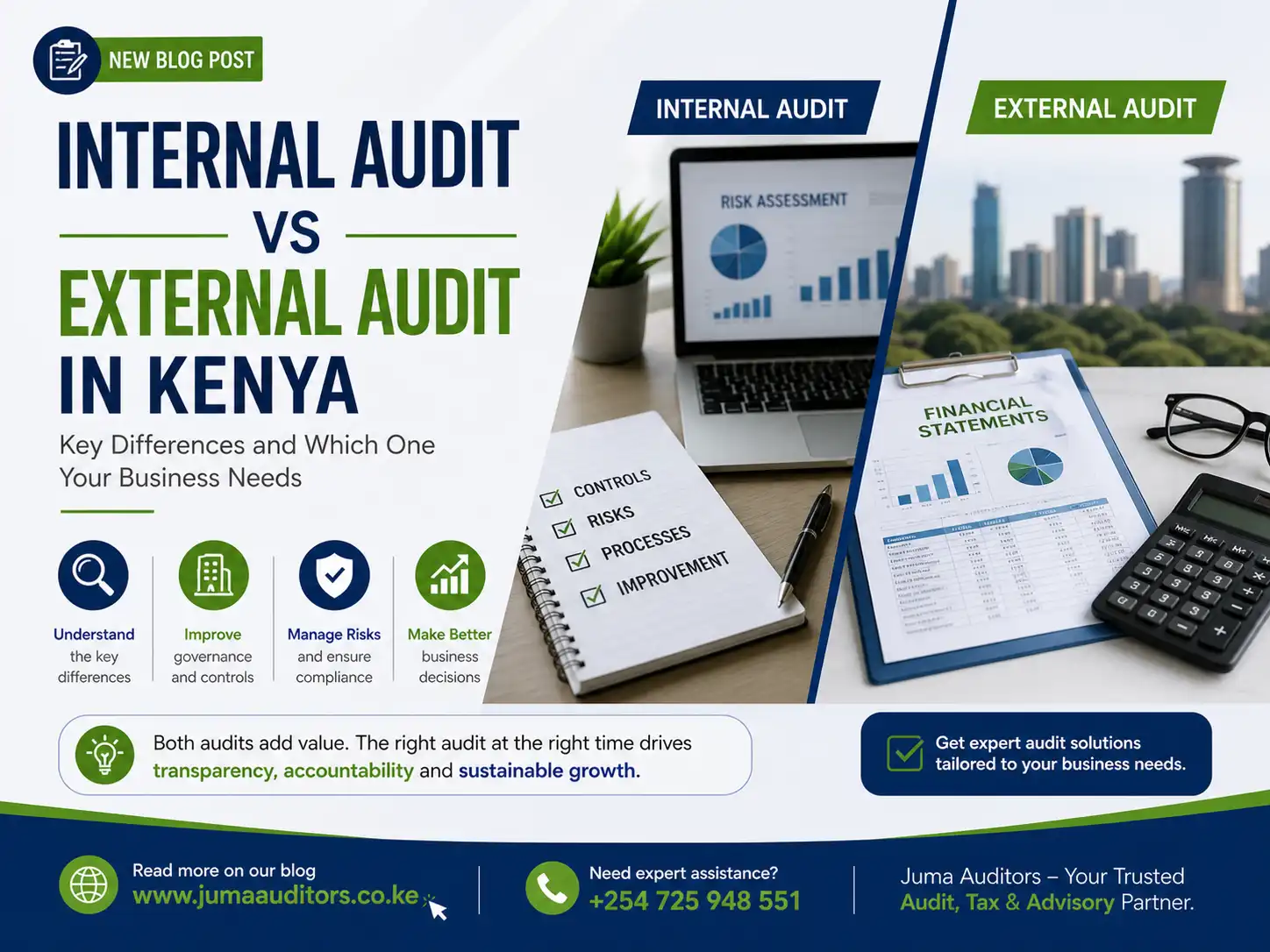
If you run a business in Kenya, chances are you have heard the terms “internal audit” and “external audit” used interchangeably — sometimes even by the same person. They are not the same thing. They serve different purposes, are conducted by different people, and produce different outcomes.
Understanding the distinction is not just an academic exercise. It helps you know which audit your business is legally required to have, which one is optional but valuable, and when you need both working together.
This guide explains everything — clearly, and in the Kenyan context.
The Simple Version First
Think of it this way:
- An internal audit looks inward — it examines how well your business is running, whether your controls are working, and where the risks are. It reports to management.
- An external audit looks outward — it examines your financial statements to tell shareholders, regulators, banks, and the public whether your numbers are accurate and trustworthy. It reports to shareholders and regulators.
One improves how you operate. The other proves to the outside world that your finances are sound. Both matter — but for different reasons.

What Is an Internal Audit?
An internal audit is an independent, objective review of a company’s internal controls, risk management processes, and operational efficiency. Its primary goal is to add value and improve operations — not to produce a report for an outside regulator.
The internal audit function can be staffed in two ways:
- In-house — a dedicated internal audit department or team employed by the company
- Outsourced — a qualified accounting or audit firm is engaged to perform the internal audit function on the company’s behalf
For most Kenyan SMEs and medium-sized organisations, outsourcing the internal audit function is more practical and cost-effective than maintaining a full internal audit department.
What does an internal audit cover?
The scope of an internal audit is flexible and set by management or the audit committee. Common areas include:
- Review of internal controls (procurement, cash handling, payments authorisation)
- Payroll and HR compliance — PAYE, NSSF, SHIF deductions and remittances
- Inventory and asset management
- IT systems and data security
- Fraud risk assessment and prevention
- Compliance with company policies and procedures
- Operational efficiency and process improvement
Internal audits can be conducted quarterly, semi-annually, or on a continuous basis depending on the size of the organisation and its risk exposure.
Who does the internal auditor report to?
The internal auditor reports to management — typically the board of directors or the audit committee. The findings are used internally to fix weaknesses, reduce risk, and improve efficiency. Internal audit reports are not shared with KRA, regulators, or external stakeholders.
What Is an External Audit?
An external audit is an independent examination of a company’s financial statements conducted by a qualified auditor who has no connection to the company. The purpose is to give an objective opinion on whether the financial statements present a true and fair view of the company’s financial position and performance.
The external auditor is appointed by the shareholders — not management — which is what gives the audit its independence and credibility.
In Kenya, external audits must be conducted by practicing members of ICPAK (Institute of Certified Public Accountants of Kenya) holding a valid practicing certificate, affiliated with a registered audit firm. The audit is carried out in accordance with International Standards on Auditing (ISA) and financial statements must comply with IFRS or IFRS for SMEs.
What does an external audit cover?
The scope of an external audit is standardised and focuses specifically on the financial statements:
- Verification that the income statement, balance sheet, and cash flow statements are accurate
- Testing of transactions, account balances, and supporting documentation
- Evaluation of financial reporting controls
- Assessment of compliance with the Companies Act 2015, tax laws, and applicable accounting standards
- An opinion on whether the financial statements give a true and fair view
Who does the external auditor report to?
The external auditor reports to shareholders and, by extension, to regulators, lenders, and any external party relying on the financial statements. The audit report is a formal public document filed with the Registrar of Companies.
Side-by-Side Comparison
| Factor | Internal Audit | External Audit |
|---|---|---|
| Purpose | Improve operations, controls, and risk management | Provide independent assurance on financial statements |
| Who conducts it | Employees or outsourced audit firm | Independent registered audit firm (ICPAK-certified) |
| Who appoints them | Management / board of directors | Shareholders |
| Reports to | Management / audit committee | Shareholders, regulators, public |
| Scope | Flexible — operations, controls, compliance, IT, HR | Standardised — financial statements only |
| Frequency | Continuous, quarterly, or semi-annually | Annually (typically at financial year-end) |
| Legally required? | No — optional (but recommended) | Yes — for companies, NGOs, SACCOs, and other regulated entities |
| Output | Internal report with recommendations | Formal auditor’s report filed publicly |
| Focus | Future-oriented — prevent and improve | Past-oriented — verify what happened |
| Relationship with company | Close working relationship with management | Strictly independent — no personal or financial ties |
Does Your Business Need an Internal Audit, an External Audit, or Both?
The honest answer: it depends on your size, legal structure, and risk profile. Here is a practical guide.
You need an external audit if:
You are a registered company (private or public) in Kenya — the Companies Act 2015 requires your financial statements to be audited annually. The same applies if you are an NGO (required by the NGO Coordination Board), a SACCO (required by SASRA), a school, a bank, an insurance company, or any entity whose regulator or major funder mandates it.
Even if your company technically qualifies as a “small company” under the Companies Act, KRA requires audited financial statements when you file your annual corporate tax returns. In practice, almost every registered company needs an external audit to stay compliant.
→ See our full guide: What Is a Statutory Audit in Kenya and Does Your Company Need One?
You need an internal audit if:
You are a growing SME or mid-sized organisation that wants to get ahead of problems before they become expensive. Internal audits are particularly valuable when:
- Your business handles significant cash, stock, or inventory
- You have multiple employees or departments with financial responsibilities
- You are preparing for a statutory external audit and want your records to be clean
- You suspect fraud, leakage, or control weaknesses
- A bank, investor, or donor requires evidence of strong internal controls
- You are scaling up and want to ensure your processes grow with the business
You need both if:
Most medium-sized companies, NGOs, and SACCOs benefit from having both. The two functions are not competing — they are complementary. A well-run internal audit throughout the year means the external audit at year-end is smoother, faster, and less likely to uncover surprises.
As one principle holds true across audit practice: when internal auditors effectively manage risk and maintain strong control systems, external auditors can rely on that work — making the external audit more efficient and often less costly.
Can the Same Firm Do Both?
This is a common question — and in Kenya the answer is nuanced.
The external audit must always be independent. The same firm that prepares your books or provides day-to-day accounting services generally should not also be your statutory external auditor, because this creates a self-review threat to independence.
However, it is entirely acceptable — and common — for an audit firm to:
- Carry out your internal audit function (outsourced)
- Separately, engage different professionals from within the firm for the external audit
For smaller Kenyan businesses, a practical approach is to appoint one firm for bookkeeping and internal audit support, and a separate registered audit firm for the statutory external audit. This preserves independence while keeping costs manageable.
Real-World Examples: Which Audit Applies?
A Nairobi-based import company with 12 staff and KES 80M turnover Needs: External audit (Companies Act requirement; above small company threshold). Would benefit from: Internal audit quarterly — cash management, procurement controls, import documentation.
A church-based SACCO with 300 members Needs: External audit (SASRA requirement — audited accounts due to SASRA by 15 March). Would benefit from: Internal audit to review loan appraisals, member records, and treasury controls.
An NGO running donor-funded health programmes Needs: External audit (NGO Coordination Board + donor requirements). Needs: Internal audit — most major donors (USAID, EU, UN) require evidence of functioning internal controls as a grant condition.
A sole trader running a small retail shop Needs: Neither is legally required. However, if applying for a bank loan, the bank may request audited or reviewed accounts.
Frequently Asked Questions
Is an internal auditor the same as an external auditor? No. An internal auditor works for (or is contracted to) the company and reports to management. An external auditor is fully independent of the company and reports to shareholders. Their objectives, scope, and outputs are all different.
Can my company accountant conduct the internal audit? Your in-house accountant can assist with internal controls reviews, but a proper internal audit is ideally carried out by someone independent of the function being audited. For small businesses, outsourcing the internal audit function to a third-party firm gives you better objectivity and more useful findings.
How often should an internal audit be done? It depends on your risk exposure. High-risk areas (cash handling, payroll, procurement) benefit from quarterly reviews. Operational audits of lower-risk areas can be done annually. Many Kenyan SMEs start with a full internal audit once a year and add targeted reviews as they grow.
Will having an internal audit reduce my external audit fees? Often, yes. When your records are well-maintained and internal controls are documented and tested, the external auditor has less ground to cover. This can reduce both the time taken and the fees charged for the statutory audit.
Get the Right Audit Support for Your Business
Whether you need an external audit to meet your statutory obligations, an internal audit to strengthen your controls, or both — the key is working with a qualified, experienced team that understands the Kenyan regulatory environment.
At Juma Auditors, we provide both external audit and internal audit services for companies, NGOs, SACCOs, and other entities across Kenya. Our ICPAK-registered CPAs deliver practical, timely, and insightful audit services that go beyond compliance — helping you run a stronger, more transparent business.
📞 Call us: +254 725 948 551 📧 Email: info@jumaauditors.co.ke 🌐 Visit: www.jumaauditors.co.ke 📍 Office: Kimathi Chambers, 5th Floor, Nairobi